

A Scotland Walking Day for a Relaxed September Weekend
Choose a Scottish woodland, loch, coastal or hill setting, then use an official route guide to match the walk to your group and verify the live details.

Lead software engineer and technical consultant working across React, Next.js, TypeScript, Node.js, product delivery, and team leadership.
- scotland walking
- official route guides
- september day trip
- weekend walk
- route selection
On this page
- A Scotland walking day without a guessed itinerary
- Pick the landscape before debating the exact route
- Forest or woodland
- Loch or coastline
- Mountain or hill
- Let the least flexible need shape the choice
- What must be checked on the individual route
- Access
- Effort and suitability
- Current conditions and safety
- Timing
- A practical September decision path
- Keep the day social rather than tightly scheduled
- The five-minute agreement before committing
- Make September’s plan simple
- Official sources
Choosing a weekend walk sounds simple until someone asks which route, how demanding it is, whether everyone can reach it and what happens if the weather changes. Those questions matter on a September weekend, especially when the point is to spend relaxed time together rather than force the group through a rigid itinerary.
The useful idea here is deliberately modest: choose one Scotland walk from an official route guide, match it to the people coming and leave enough flexibility to enjoy the setting. The supplied tourism source supports walking options across mountains and hills, forests and woodlands, lochs and coastlines. It does not confirm a particular trail, journey time, access arrangement or current condition, so those details need to be checked live before anyone leaves.
A Scotland walking day without a guessed itinerary
VisitScotland’s walking overview introduces route guides and several types of Scottish landscape, including mountains, hills, forests, woodlands, lochs and coastlines (VisitScotland walking overview). That is enough to shape a real weekend decision, but not enough to name a route responsibly.
So the plan is not “go to this exact trail at this exact hour.” It is:
- Decide which landscape suits the group.
- Open the official walking resource and select an individual route guide.
- Verify the route-specific access, effort, timing and safety information.
- Check current weather, conditions and any notices close to departure.
- Keep the rest of the day loose enough for pauses or a meal.
That distinction prevents an appealing suggestion from turning into unsafe or impractical advice. It also gives the group room to choose according to its own pace, location and budget.
Pick the landscape before debating the exact route
The official overview supports several broad walking environments: mountains and hills, forests and woodlands, lochs and coastlines. Each points toward a different kind of day, but the source metadata does not describe individual surfaces, gradients or facilities. The comparisons below are therefore a planning interpretation, not verified route descriptions.
Forest or woodland
A woodland setting may appeal when the group wants the walk itself to be the main activity without committing in advance to a dramatic summit or exposed coastal objective. That does not mean every woodland route is easy, sheltered or accessible. Those qualities vary and must be confirmed on the individual guide.
Choose this category first if the shared preference is trees, a contained landscape and a walk that can stand on its own without a long list of additional stops.
Loch or coastline
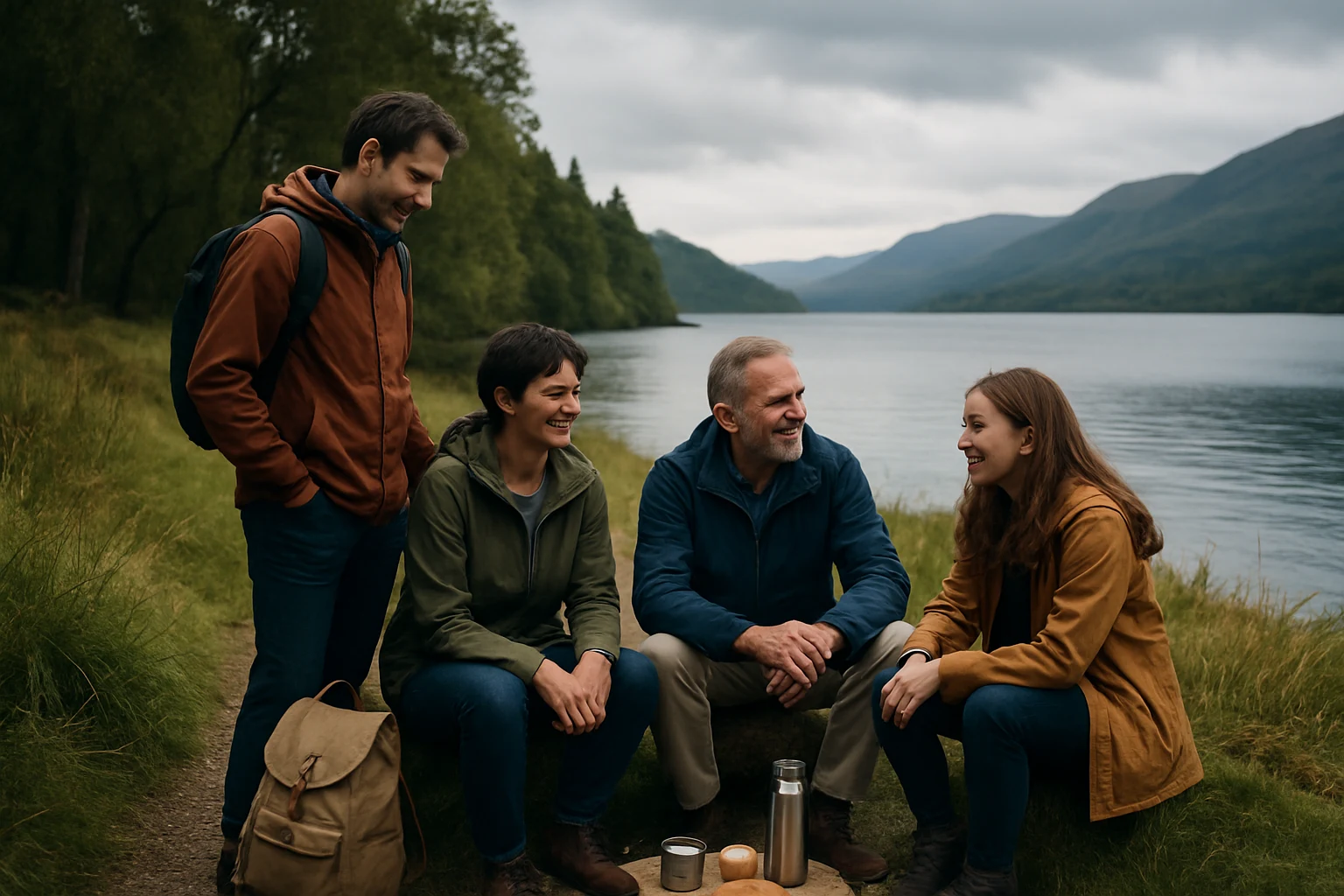
A lochside or coastal setting gives the day a clear scenic theme. It can work nicely for friends or family who enjoy stopping to look around rather than treating the outing as a continuous march.
However, the overview does not establish whether any particular waterside route is level, paved, exposed, circular or close to facilities. Do not infer those details from the word “loch” or “coast.” Confirm them on the selected route page and through current local information.
Mountain or hill
Mountains and hills are also represented in the official walking overview, but the supplied metadata gives no difficulty or safety information for a named route. A hill walk should therefore be chosen only after the group has read the specific guide and compared its demands with everyone’s ability and comfort.
If the group is divided between “a gentle social walk” and “a bigger hill day,” settle that difference before choosing a destination. The setting should follow the group, not the other way around.
Let the least flexible need shape the choice
A relaxed day becomes much easier to plan when the group starts with its real constraints. Ask a few plain questions before anyone becomes attached to a photograph or place name:
- How much walking does everyone genuinely want?
- Does anyone need confirmed step-free or wheelchair access?
- Is public transport required, or will the group use a car?
- Is there a firm return time?
- Are children or people with limited walking experience joining?
- Does the group want a hill, woodland, loch or coastal setting?
- Is a café or meal important enough to influence the location?
These questions are decision prompts, not claims about facilities on Scottish routes. The supplied overview does not confirm accessible paths, parking, public transport, toilets, food venues or opening hours for a specific destination.
When one of those features is essential, treat it as a requirement to verify rather than a pleasant assumption. For example, “we need step-free access” is useful. “This looks like a flat path, so it will probably be fine” is not.
What must be checked on the individual route
Once the group has chosen a landscape category, use the official route material to investigate a particular walk. The VisitScotland overview says it includes route guides, but the supplied summary does not expose their individual details. The following items therefore require a live check:
Access
Confirm where the route begins and how the group can legally and practically reach it. Check any route-specific information about transport, parking, path access and accessibility. If an accessible route is required, look for an explicit description rather than relying on imagery.
Effort and suitability
Look for the route’s stated distance, terrain, ascent and expected duration, if provided on the selected guide. None of those values is available in the supplied metadata, so no universal estimate belongs in this plan.
The right route is the one that matches the whole group’s current ability and willingness. A shorter option can leave more time for conversation, pauses and food; a longer option may suit people who want the walk to occupy most of the day. That is a trade-off, not a ranking.
Current conditions and safety
Check current weather, route notices and local safety information before setting out. Conditions and availability can change, and the supplied overview does not establish what will be true on a particular September day.
If the official information is incomplete or the conditions exceed the group’s comfort, choose another guide or postpone the outing. Flexibility is part of the plan, not a failure of it.
Timing
Do not copy a generic departure time. Work backwards from the chosen route’s verified duration, daylight considerations, travel requirements and any firm return deadline. Add whatever margin the group needs for rests and an unhurried pace.
This is a planning method, not a calculated schedule. No route duration or travel time has been supplied.
A practical September decision path
Here is a concrete example of how to turn the source into one day out without inventing a destination.
The starting preference: A small group wants a Scotland walk on a September weekend, with time to talk and the possibility of eating together afterwards.
First decision: The group chooses one supported setting—forest or woodland, loch, coastline, mountain or hill—using the categories presented by VisitScotland.
Second decision: Someone opens the official walking overview and follows an appropriate route guide rather than selecting a trail from an unsupported social post.
Third decision: The group checks the individual route for access, effort, duration and relevant safety guidance. If those details do not suit everyone, it returns to the guide and chooses another route.
Fourth decision: Close to the outing, the group checks current weather and route information. If the original idea no longer fits, it switches setting, shortens the plan or chooses another day.
Optional food stop: If everyone wants a meal afterwards, select a venue near the confirmed route and check its current opening, booking requirements, menu and prices directly. No restaurant availability, quality or cost is verified by the supplied sources.
The result is still one specific weekend activity—a Scotland walk selected through an official route guide—but the unsupported parts remain open until they can be verified.
Keep the day social rather than tightly scheduled
A route can provide the structure without controlling every minute. Agree on the non-negotiables—meeting point, chosen walk, essential access needs and return constraints—then leave the softer parts flexible.
One group might prefer a shorter route and a longer meal. Another might carry its own food and spend more time outside. Families may need more pauses, while regular walkers may choose a route whose verified demands are more substantial. Budget can shape transport and food choices without changing the core idea.
This flexibility also avoids presenting one itinerary as universally correct. The official tourism overview provides categories and route-guide direction; the group supplies its own priorities.
The five-minute agreement before committing
Before calling the plan settled, make sure everyone can answer these questions:
- Which official route guide are we using?
- What does that guide say about effort and timing?
- How will each person reach the start?
- Have any essential accessibility needs been explicitly confirmed?
- Where will we check current weather, safety information and route notices?
- What is our simpler alternative if the first choice no longer works?
- If food matters, has the venue’s current opening and availability been checked?
Anything unanswered remains a live-check item. That label is useful: it separates an attractive idea from a confirmed arrangement.
Make September’s plan simple
For this weekend reset, start with one choice: woodland, loch, coast, mountain or hill. Use VisitScotland’s walking material to find the individual route, then confirm the practical details the overview alone cannot provide.
There is no need to create a perfect itinerary. Choose a walk that fits the group, leave time to notice the landscape and add food only when the current details work. Save the idea, send it to someone you would enjoy walking with and make the final route decision together.
Official sources
- VisitScotland Walking — relevant official tourism source for Scotland walking categories and route-guide discovery.
- Go documentation: Security — supplied source, but unrelated to this weekend walking plan and not used as evidence.
- Rust documentation: Tools — supplied source, but unrelated to this weekend walking plan and not used as evidence.
