

A relaxed Santiago de Compostela weekend plan: walk, look, eat
A flexible Santiago de Compostela weekend plan built around the Cathedral, historic squares, Alameda Park, and Galician food—with practical checks for weather, access, opening times, and group pace.

Lead software engineer and technical consultant working across React, Next.js, TypeScript, Node.js, product delivery, and team leadership.
- santiago de compostela weekend plan
- galicia food market
- plaza del obradoiro
- alameda park
- historic city walk
On this page
- Santiago de Compostela weekend plan: one historic centre, several natural pauses
- A gentle route through the Cathedral area and Alameda Park
- Make the meal part of the plan, not an afterthought
- What to check before leaving home
- Three versions of the same Santiago weekend idea
- The short version
- The balanced version
- The food-led version
- What this plan deliberately leaves open
- A simple decision path for your next free weekend
- Official sources
The hardest part of a free weekend is often not finding somewhere to go. It is finding an idea that feels complete without becoming another project: enough to see, something good to eat, and room for different people to move at different speeds.
Santiago de Compostela offers a useful answer. The official Spain Tourism description presents it as a city where the Cathedral and historic centre sit alongside parks, a food market, restaurants, contemporary culture, and a younger university atmosphere. That makes it possible to build a flexible city break around one simple rhythm: walk towards the historic centre, pause around the Cathedral, take a quieter green-space break, and let the meal decide how the day continues.
This is not a pilgrimage itinerary, a timed checklist, or a claim that one day is enough to experience the city. It is a practical weekend idea for people who want an inviting plan they can shorten, stretch, or rearrange.
Santiago de Compostela weekend plan: one historic centre, several natural pauses
The useful mechanism here is variety without complicated logistics. A group can spend time around the Cathedral, change the mood with Alameda Park, and finish with a market or tapas stop. The source does not provide a walking distance, a fixed route, or an official timetable for every attraction, so the safest interpretation is a loose sequence rather than a measured itinerary. (Spain Tourism)
That flexibility matters when the group is mixed. One person may want to look closely at architecture. Someone else may prefer a bench, a coffee-like pause, or a slow conversation. Families may need more breaks. Friends may want to wander without agreeing on every next stop. A city-centre plan can accommodate those differences more easily than a route that depends on everyone maintaining the same pace.
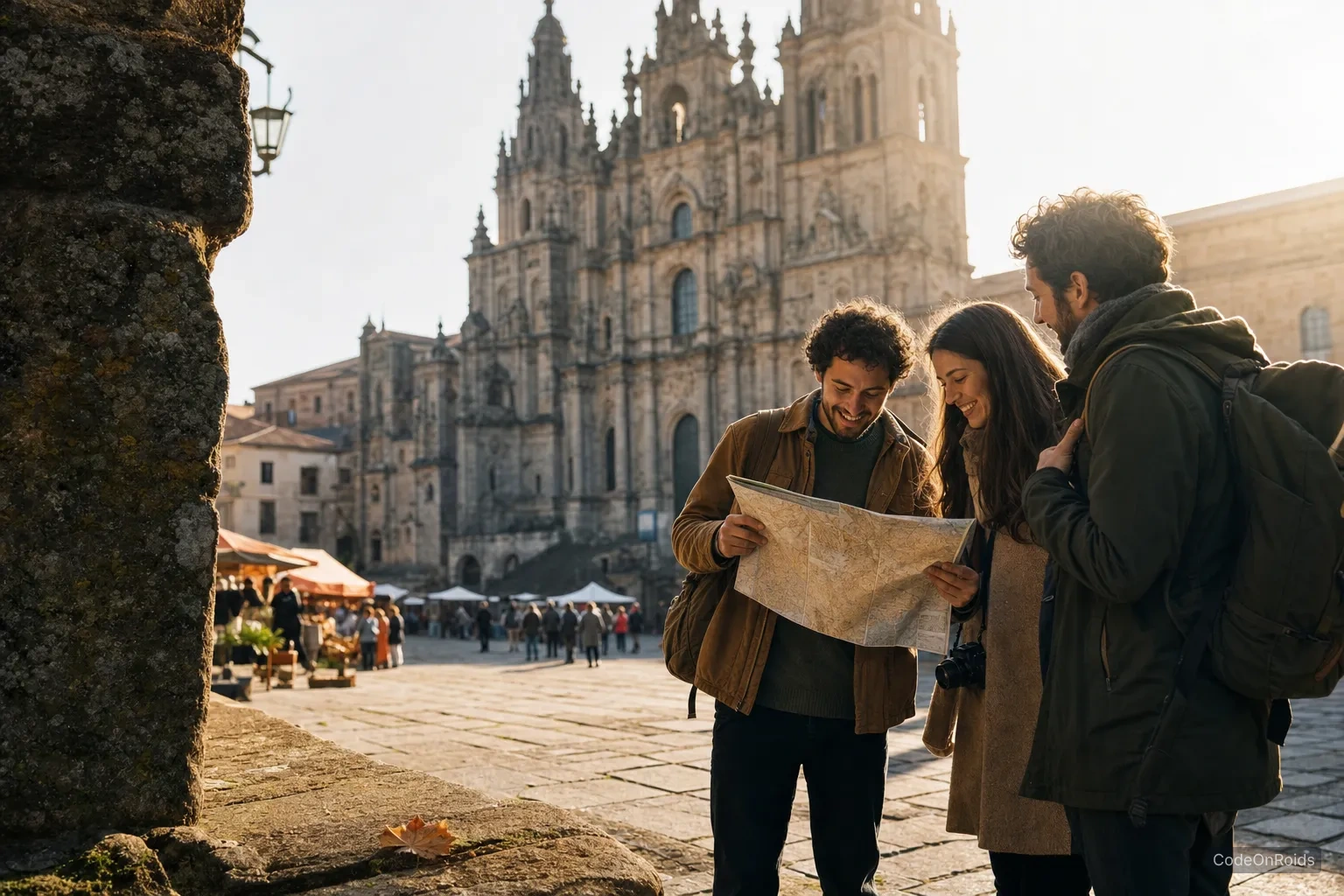
The starting point for the idea is Plaza del Obradoiro, described by Spain Tourism as the place around which city life seems to revolve. The Cathedral, Raxoi Palace, and Hostal dos Reis Católicos frame the square, and pilgrims are commonly seen there with walking sticks and scallop shells. (Spain Tourism)
The practical decision is not whether to “complete” every nearby sight. It is deciding how much attention the group wants to give the area. You might look at the Pórtico de la Gloria, the High Altar, and the crypt, or simply spend time noticing the square and the movement around it. Spain Tourism also mentions cathedral rooftops, but any visit details should be checked before going.
A gentle route through the Cathedral area and Alameda Park
A relaxed version of the plan can use three mood changes.
First, begin with the Cathedral area. Plaza del Obradoiro gives the day a clear landmark and a sense of arrival. From there, the nearby squares of Praterías and Quintana offer more architectural detail. Spain Tourism specifically notes the view of the Berenguela from Praterías and the staircase and monuments around Quintana, including the Monastery of San Martiño Pinario. (Spain Tourism)
Second, allow the historic centre to remain open-ended. The source describes narrow streets, stone houses, and palaces, as well as “discovery” around the Cathedral. That supports a slow wander, but not a promise that every street will be quiet, accessible, or easy for every visitor. If someone in the group has mobility requirements, check the current route and access information directly before setting out.
Third, change the texture with Alameda Park. Spain Tourism calls it quiet and also mentions its viewpoint of Monte do Gozo, with pilgrim sculptures that have appeared in many photographs. The source does not establish a specific walking time between the historic centre and the park, nor does it confirm current conditions, so treat this as an optional green-space extension rather than a guaranteed route. (Spain Tourism)
That optional quality is part of the appeal. If the weather turns unpleasant, if a child is tired, or if the group simply prefers a longer meal, Alameda Park can be saved for another visit. If everyone wants more air and space, it can become the day’s slower middle chapter.
Make the meal part of the plan, not an afterthought
The food decision is straightforward: use Santiago’s market and old-town food culture as the second anchor of the day.
Spain Tourism describes the Mercado de Abastos as the city’s second most visited place and says visitors can buy or taste seafood from the rías, cheeses, and Padrón peppers, as well as try tapas. The source also points to Calle Franco and Calle Raiña for restaurants and tapas, and names octopus “a feira,” scallops, Santiago cake, and Albariño among the local food and drink to look for. (Spain Tourism)
This is useful for groups because it does not force one kind of meal. A market visit can be exploratory. Tapas can turn eating into a shared activity. A sit-down restaurant may suit people who want a slower pause. The source does not provide prices, current opening hours, reservations, or availability, so those details need a live check before you commit.
A good preparation question is: does the group want a planned meal or a food neighbourhood to explore? If the answer is planned, check a specific venue and its hours independently. If the answer is exploratory, keep the market and the old-town streets as options rather than promises. Either way, avoid presenting a particular restaurant experience unless you have verified it separately.
What to check before leaving home
The supplied tourism source supports the destination, sights, food ideas, and general city character. It does not support a complete access or safety plan. Use this short checklist to fill that gap with live information:
- Check the current weather for Santiago de Compostela on the day you travel. The source excerpt includes a Galicia/A Coruña weather display, but that is not a reliable Santiago forecast for your specific weekend.
- Confirm Cathedral access, rooftop visits, crypt access, and any visitor requirements directly before going.
- If seeing the botafumeiro matters to the group, check the current schedule or arrangement. Spain Tourism says it operates only on certain holidays or by prior arrangement.
- Check Mercado de Abastos and restaurant opening times, especially if your plan depends on a particular meal.
- Confirm current access information for the route and attractions if anyone in the group has mobility, sensory, or family-related needs.
- Bring footwear and layers appropriate for a city walk and the weather you actually find, rather than relying on a generic seasonal assumption.
The last point is intentionally modest. The date in this editorial is 10 October, so autumn is a reasonable planning lens, but the supplied source does not establish the day’s conditions in Santiago. Prepare for the forecast you verify, not the season you imagine.
Three versions of the same Santiago weekend idea
The plan can be adapted without losing its shape.
The short version
Spend time in Plaza del Obradoiro, look around the nearby Cathedral squares, and choose one food stop in the old town or at the market. This suits a group that wants atmosphere without a long day. The source supports all three elements, but the exact order and opening details should be checked.
The balanced version
Give the Cathedral area the first part of the day, take a break around Alameda Park, then explore the Mercado de Abastos or the tapas streets. This adds a change of pace without requiring a specific hiking route. Alameda Park is an interpretation of the source’s quiet park suggestion, not a claim about a measured or officially designated itinerary.
The food-led version
Make the market and old-town food streets the main invitation, with the Cathedral and historic squares as the visual and cultural setting. Look for the food categories named by Spain Tourism—seafood, cheeses, Padrón peppers, tapas, octopus “a feira,” Santiago cake, or Albariño—while treating actual availability as something to confirm locally. (Spain Tourism)
These versions are not ranked. The right choice depends on the people coming, the weather, energy levels, and whether the group prefers architecture, green space, food, or a mixture of all three.
What this plan deliberately leaves open
A useful weekend plan should make decisions easier without pretending uncertainty has disappeared. This one leaves several details open on purpose.
It does not specify a transport method because the supplied source does not provide one. It does not promise that every attraction will be open. It does not assign a budget because no prices are included. It does not claim that the city centre or park will suit every mobility need without a live access check. It also does not turn the Cathedral into a photo stop only: visitors may want a religious, historical, architectural, or simply observational experience, and the source supports several ways of engaging with the area.
The plan’s strength is therefore not a hidden perfect route. It is the ability to combine a clear landmark, optional walking, a park, and local food while leaving enough space for real people and real conditions.
A simple decision path for your next free weekend
Start by choosing the group’s main mood: historic, green, food-focused, or mixed. If historic wins, centre the day on Plaza del Obradoiro, the Cathedral, Praterías, and Quintana. If green wins, keep Alameda Park as the main pause, but verify access and conditions. If food wins, check the market and old-town options before travelling. If the group is undecided, use the balanced version and keep the park and meal flexible.
Then check the live details: weather, opening times, Cathedral arrangements, food availability, and access. Finally, agree on only one fixed point—perhaps the place to meet or the meal window—and let the rest of the day breathe.
Santiago de Compostela can be a very good setting for that kind of weekend: a recognisable historic centre, places to pause, a park for a change of pace, and a food culture that gives the day an easy ending. Save the idea, send it to someone who needs a proper break, and make the plan fit your people rather than forcing everyone into one perfect itinerary.
