

A Málaga Weekend Plan: History, Harbour, and Sardine Skewers
A flexible Málaga weekend plan built around the historic centre, selected museums, a walk by La Malagueta and the harbour, and local food in Pedregalejo or central tapas spots. Check live details, then adapt the pace to your group.

Lead software engineer and technical consultant working across React, Next.js, TypeScript, Node.js, product delivery, and team leadership.
- malaga weekend
- malaga city break
- malaga food
- pedregalejo
- historic malaga
On this page
A free weekend can be surprisingly difficult to use well. One person wants culture, another wants the sea, someone else is thinking about food, and nobody wants a tightly packed itinerary that turns a break into a timetable. Málaga offers a useful answer: build the day around a few nearby kinds of pleasure, then leave enough room to change pace.
This is not a claim that every attraction will suit every visitor, or that every venue will be open when you arrive. It is a flexible city-break idea supported by the official Spain Tourism guide to Málaga: begin with history in the centre, move toward the beach and harbour, and make local food part of the evening. The guide describes Málaga as a Mediterranean city with beaches, museums, historic monuments, lively neighbourhoods, tapas, and a transformed port area (Spain Tourism).
A Málaga weekend plan for a mixed group
The practical problem is choosing a plan that works for different appetites. A museum-lover may want time indoors. Someone else may prefer a long outdoor stroll. Families may need flexibility, while friends might care most about where to eat later.
The Málaga idea works because it does not depend on one single activity. Its shape is a sequence of options:
- Start with the historic centre. Walk through the older part of the city and choose one or two landmarks rather than trying to absorb everything.
- Add culture according to the group. The official guide mentions the Picasso Museum and Birthplace, Carmen Thyssen Museum, Centre Pompidou Málaga, the Russian Museum Collection, the Contemporary Art Centre, and urban art in Soho.
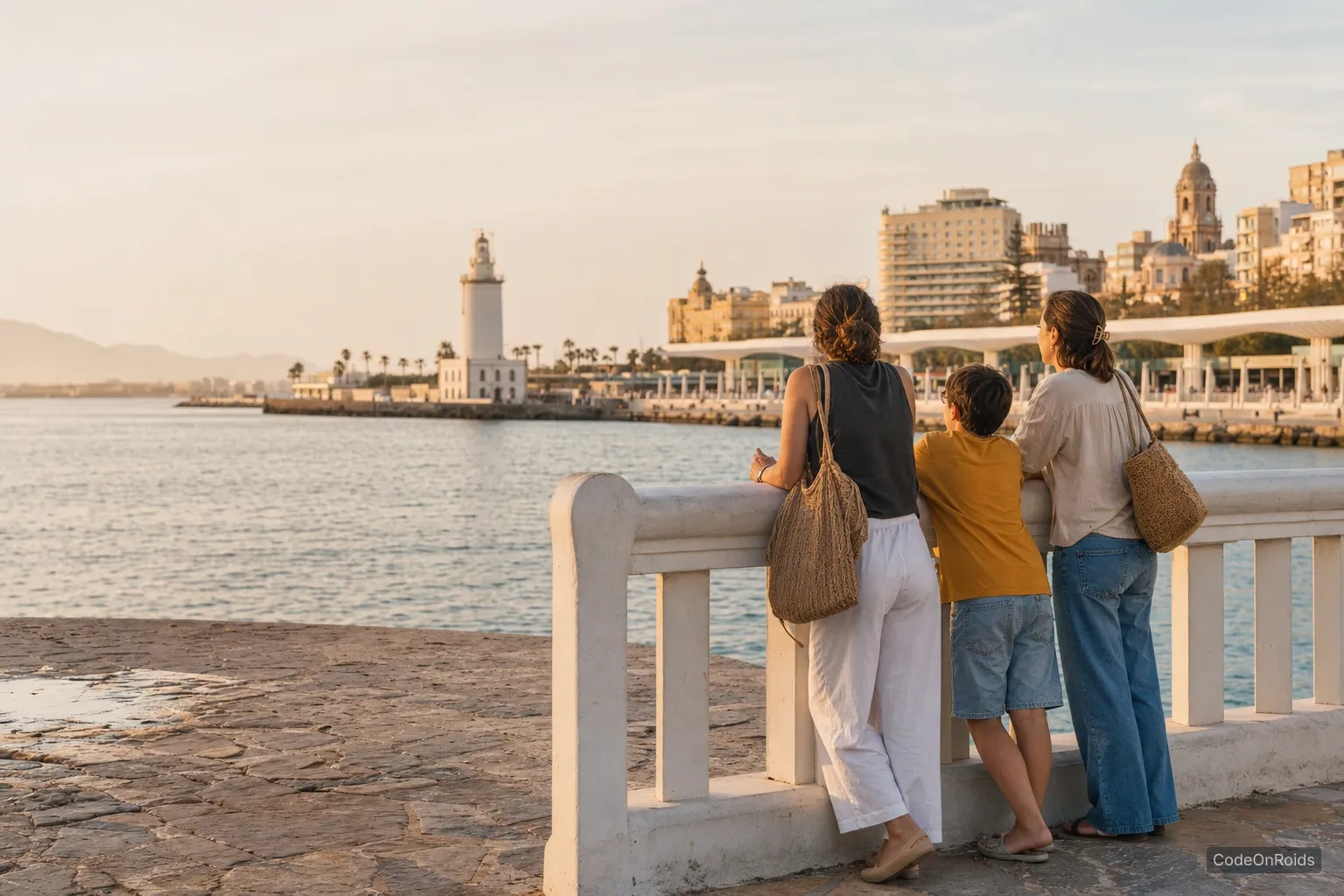
- Move toward the water. La Malagueta, Pier 1, and La Farola create a change of scenery without requiring the day to become a formal hike.
- Finish with a local flavour. Pedregalejo is highlighted for charcoal-grilled sardine skewers, while the centre and surrounding streets are associated with tapas and traditional dishes such as ajoblanco.
That structure gives the group a decision path instead of a rigid schedule. If the weather or energy is not right for a long walk, spend more time around the cultural stops. If everyone wants air and open space, make the harbour and beach side the centre of the afternoon. If food is the main event, protect time for Pedregalejo and verify current restaurant details before leaving.
Begin with history, not a checklist
Málaga’s historic layer makes a strong first section because several notable places are described close to the centre. The official source names the Alcazaba, one of the largest Arab fortresses in Andalusia, and Gibralfaro Castle. It also places the Roman Theatre and historic quarter at the foot of the castle area (Spain Tourism).
For a relaxed weekend, the useful interpretation is to treat these places as anchors for wandering rather than as boxes to tick. Pick a landmark that interests the group, allow time for the surrounding streets, and resist the urge to turn every stop into a race to the next one.
The source also describes Málaga Cathedral, known as “La Manquita” because of its unfinished right-hand tower, and mentions its rooftop as a distinctive experience. Whether that rooftop fits your day depends on current access, opening times, availability, and the group’s appetite for stairs or viewpoints. Those details need a live check; the supplied source does not provide a timetable or booking information.
The same principle applies to museums. Málaga has a particularly rich menu of options: Picasso-related places, Carmen Thyssen, the Centre Pompidou Málaga, the Russian Museum Collection, and the Contemporary Art Centre. You do not need to choose on behalf of everyone. Agree on one cultural priority, then keep the rest of the day open.
That trade-off matters. A longer museum visit may give the day more focus, but it leaves less time for the coast and harbour. A shorter cultural stop creates a more outdoor-oriented plan, but may feel too brief for someone who came mainly for art. There is no universally correct balance; the right choice depends on the group.
Move from the city to the sea
The second half of the plan changes the texture of the day. The official Málaga guide describes La Malagueta city beach as a place to spend a sunny day, and identifies nearby Pier 1 as a harbour promenade with shops and restaurants. It also points toward La Farola, a lighthouse described as a symbol of the city (Spain Tourism).
This is the part to keep deliberately unhurried. A promenade gives people room to talk, pause, take photographs, or simply look out toward the water. It also gives a mixed group an easier way to adapt than a fixed attraction schedule.
The source specifically suggests strolling along the harbour at sunset until reaching La Farola. Sunset timing changes by date, and the supplied material does not confirm current access or conditions, so check the live forecast and local information before relying on that exact timing. The broader idea remains simple: leave the centre with enough daylight or evening time for a walk beside the water.
A useful preparation list is modest:
- Check the live weather before setting out; the supplied page displays a maximum of 28°C and minimum of 21°C, but those figures should not be treated as a forecast for your chosen weekend.
- Confirm opening times, ticket requirements, and access for any museum, castle, cathedral, or rooftop you select.
- Wear footwear suited to a city walk and bring water, especially if your group expects to combine monuments with the beach and harbour.
- Choose a meeting point in advance if people are arriving separately.
- Keep one stop optional so a tired child, older relative, or less energetic friend can change the pace without derailing the day.
The footwear and water suggestions are practical interpretation rather than details stated by the source. They are not special route-safety claims, and this article does not provide a hiking route or advise entering any restricted area.
Make the meal part of the plan
Food is not an afterthought in this Málaga idea. The official tourism guide points to Pedregalejo, a seaside neighbourhood, and recommends trying local specialities including charcoal-grilled sardine skewers. It also mentions tapas in the central area and ajoblanco at El Pimpi Winery (Spain Tourism).
The choice between those options changes the shape of the evening. Pedregalejo keeps the coastal feeling going and makes the meal part of the seaside outing. Staying around the centre makes more sense if the group wants tapas after the historic walk or prefers not to add another neighbourhood to the plan.
Neither option should be treated as a guaranteed reservation or recommendation based on personal experience. The supplied source does not provide prices, current menus, opening times, booking requirements, or availability. Check those details directly before committing, particularly if you are travelling with a larger group.
A relaxed decision rule is enough:
- Choose Pedregalejo if the group wants to keep the sea nearby and try the sardine speciality named by the official guide.
- Stay central if tapas, the historic quarter, and a shorter evening transfer matter more.
- Leave the exact venue open if you need flexibility or have not checked current hours and availability.
This is also where budgets and dietary needs should shape the plan. No prices or dietary information are supplied here, so ask venues directly and agree on an approximate spending limit with your group rather than assuming the meal will fit everyone automatically.
Three versions of the same day
The plan can be adjusted without losing its character.
The culture-first version: Choose the historic centre, one major monument, and one museum. End with a shorter walk toward the harbour before dinner. This suits a group that wants Málaga’s cultural side to lead the day.
The sea-and-food version: Keep the historic section brief, spend more time around La Malagueta and Pier 1, then continue toward the evening meal. Pedregalejo can be the food focus if current opening details work for your group.
The family-flexible version: Select one clear landmark, one outdoor stretch, and one meal destination. Make the museum or additional monument optional. This reduces the risk that one slow section makes the whole day feel hurried.
These are planning interpretations, not official itineraries. The source supports the ingredients—historic sites, museums, beach, harbour, lighthouse, neighbourhoods, tapas, and sardines—but it does not specify a route, travel time, transport method, or schedule. Treat those parts as choices to verify and adapt.
A simple decision path before you go
Start by asking what your group actually wants from the weekend: history, art, sea air, food, or a balanced mix. Then choose one anchor from each of two or three categories instead of collecting every possible stop.
Next, check the details that can change: weather, attraction opening times, tickets, restaurant availability, and any access information. The official page is a useful starting point, but live checks are still necessary because the supplied excerpt does not confirm those conditions for your date.
Finally, protect the unplanned part of the day. Málaga’s appeal in this plan is the contrast between monuments, streets, water, and food. If every minute is assigned, the contrast becomes another obligation. A loose order—historic centre, selected culture, waterfront, meal—is enough.
A good Málaga weekend can stay uncomplicated
The most useful version of this city break is not a perfect itinerary. It is a friendly set of choices: begin among Málaga’s historic places, add a museum or two only if they suit the group, walk toward La Malagueta and the harbour, then decide whether Pedregalejo’s sardine skewers or central tapas better fit the evening.
Check the live details, adapt the effort level, and let the weather and company influence the order. Save the idea for a free weekend, send it to someone who would enjoy a slow city walk, and make a plan that leaves room for one pleasant detour.
