

How to plan a relaxed Bilbao weekend around food and a city walk
A relaxed Bilbao weekend can revolve around one flexible city walk: start with the Guggenheim, drift through the historic old town, pause for pintxos, and add a park, viewpoint, or estuary finish only if it suits the group. Here is how to adapt the plan while checking live opening, transport, weather, and access details.

Lead software engineer and technical consultant working across React, Next.js, TypeScript, Node.js, product delivery, and team leadership.
- bilbao weekend plan
- bilbao city walk
- pintxos bilbao
- guggenheim museum bilbao
- basque cuisine
On this page
- A Bilbao weekend plan that starts with one city walk
- The old town supplies the low-pressure middle
- Make pintxos the social anchor, not a reservation puzzle
- Add green space or a viewpoint only when it improves the day
- A practical decision path for different groups
- If art is the main reason for going
- If food and conversation matter most
- If the group needs a gentler pace
- If weather changes the mood
- What to prepare before leaving
- The point is a shape, not a perfect itinerary
- Official sources
The hard part of a city break is often not finding things to do. It is choosing a shape for the day that leaves room for conversation, food, weather changes, and the occasional “shall we just stop here?”
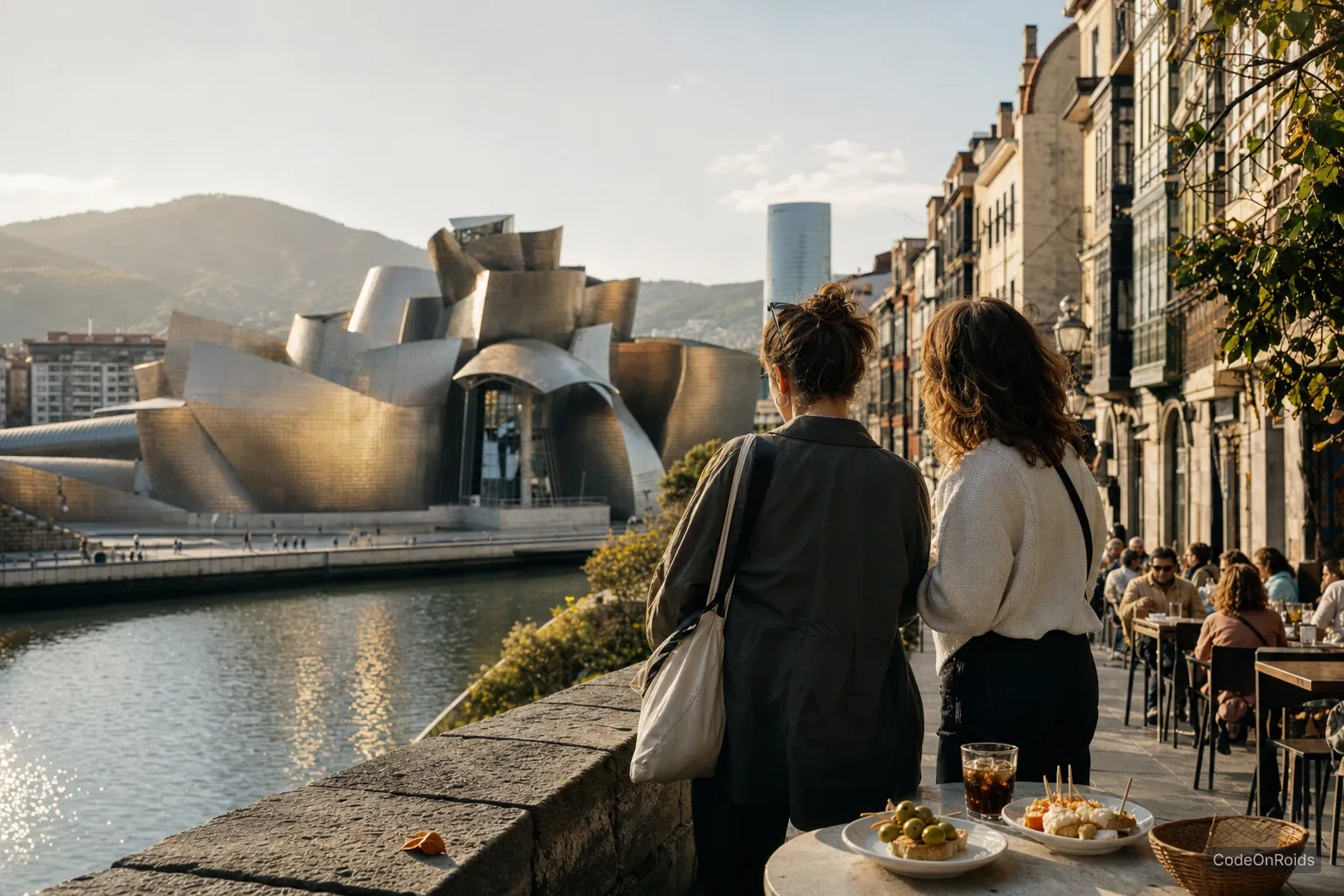
Bilbao offers a useful answer: build one relaxed city walk around a clear contrast. Begin with the city’s modern architecture and art, then move toward the old town, cafés, and small plates. Add a park, the estuary, or a viewpoint only if the group still has energy. The result is not a strict itinerary. It is a flexible weekend plan with enough anchors to make deciding easy.
This is a source-supported idea for Bilbao, not a first-hand travel report. The official tourism information describes the city’s museums, historic streets, food culture, green spaces, hills, and estuary; exact opening times, transport conditions, weather, and availability should be checked before setting out. Spain Tourism’s Bilbao guide is the reference for those destination details.
A Bilbao weekend plan that starts with one city walk
The simplest version is to choose three broad sections rather than a minute-by-minute schedule:
- Modern Bilbao: start around the Guggenheim Museum and take in the architecture and riverside setting.
- Historic Bilbao: continue toward the old town and the Siete Calles, the area described by Spain Tourism as having more than 700 years of history.
- Food and a slower finish: pause around Plaza Nueva and its surroundings for pintxos, then decide whether the day should end with a café, a park, or time beside the estuary.
That order is an interpretation of the source material, not a verified walking route or a promise about distances. The practical advantage is that every section has a different mood. The first gives the day a visual starting point, the second adds texture and history, and the third lets the group settle into eating and talking.
The Guggenheim is a natural opening landmark. Spain Tourism describes its curved structure, made with 33,000 ultra-thin titanium plates, and identifies it as one of Bilbao’s notable examples of twentieth-century architecture. The source also says the museum shares an important modern and contemporary art collection with institutions in New York and Venice. Spain Tourism
Whether you go inside is a decision to make with the group, not a requirement built into the plan. Museum opening hours, tickets, exhibitions, and access details are not supplied here, so check the official destination or museum information live before relying on a visit. If the timing does not work, the building and surrounding city walk can still serve as the opening point; that is an interpretation, not a claim about admission or current conditions.
The old town supplies the low-pressure middle
From the modern waterfront, shift the emphasis toward Bilbao’s historic centre. Spain Tourism highlights the Siete Calles, the cathedral, the Arriaga Theatre, traditional and newer cafés, and the area’s long history. Those details support a slower kind of city break: walk without trying to collect every landmark, choose a street that looks inviting, and let the next pause be part of the plan.
This is where the effort level becomes flexible. A group that wants more sightseeing can continue through the historic streets and look for buildings named in the official guide. A family group, a mixed-age party, or anyone managing a tired afternoon can shorten the walk and make the food stop the main event. The source does not provide a route length, pavement assessment, step-free details, or a guaranteed accessible path, so do not treat this as formal accessibility guidance. Check current local information if those details matter for your group.
The same principle applies to transport and timing. Bilbao’s official tourism page mentions the metro stations designed by Norman Foster, but the supplied material does not provide fares, service hours, disruptions, or a recommended journey. Use current transport information rather than assuming that a particular connection will be available.
Make pintxos the social anchor, not a reservation puzzle
Bilbao’s food culture gives this plan its most natural invitation. Spain Tourism points to Plaza Nueva and its surroundings as an area with bars serving pintxos, the small bites associated with the Basque Country. It also mentions family-run restaurants, prestigious chefs, and La Ribera Market, where visitors can find food and pintxos, wine called txakoli, and live music. Spain Tourism
The useful decision here is not “Which restaurant is the best?” The supplied source does not name a specific restaurant to recommend, provide prices, or confirm today’s availability. Instead, decide how much structure your group wants:
- Very casual: explore the Plaza Nueva area and choose a stop when everyone is ready to eat.
- More planned: identify a market or restaurant option in advance, then verify its opening hours and current service.
- Mixed preferences: agree on a general food area while allowing people to choose different bites or a café pause.
This approach keeps the meal from becoming a performance. Pintxos can be the reason to gather without turning the weekend into a search for a perfect table or a fixed tasting sequence. Budget, dietary needs, reservations, and current service should all be checked directly; none are established by the supplied excerpt.
La Ribera Market is another possible food-focused stop, but the details in the source are not enough to confirm current vendors, opening hours, live music, prices, or whether every service described is operating on a particular day. Treat it as an option to investigate, not a guaranteed part of the itinerary.
Add green space or a viewpoint only when it improves the day
Bilbao is not presented only as a museum-and-food destination. Spain Tourism describes it as a green city with Doña Casilda de Iturrizar Park, hills around the city, and an estuary where people may paddleboard, row, or take a boat. The guide also mentions the Artxanda funicular as a classic way to see Bilbao from above. Spain Tourism
These are useful branches in the plan because they change the pace. If the group wants quiet, a park may create a gentler pause after the old town. If everyone wants a broader view, the funicular is a possible add-on. If the estuary is drawing attention, time near the water can become the final scene rather than another item to tick off.
But each branch has constraints. The supplied source does not provide funicular times, boat schedules, ticket information, access details, weather conditions, water safety guidance, or current activity availability. Do not plan around a boat, paddleboard, or rowing activity without a live check. For a relaxed day, the safest interpretation is to treat the estuary as a place to observe and walk beside unless current official information supports anything more active.
A practical decision path for different groups
Use this short sequence when turning the idea into a real weekend:
If art is the main reason for going
Start with the Guggenheim Museum and verify opening information, admission, and any current exhibition details. Keep the old town and food stop as the second half of the day so the schedule does not depend on fitting in every museum mentioned by the guide. The Museum of Fine Arts is another named option, but its current hours and exhibitions also need a live check.
If food and conversation matter most
Use the Guggenheim or another central landmark only as a meeting point, then give more time to the old town, Plaza Nueva, and the food options described by Spain Tourism. Decide in advance whether your group prefers informal bar stops, a market visit, or a planned restaurant. Confirm prices, dietary suitability, service, and opening times directly.
If the group needs a gentler pace
Choose one central walk, one substantial pause, and one optional green or waterfront finish. Do not assume that a route is physically accessible based only on a destination summary. Check local access information and adapt the distance, surfaces, seating, and transport choices to the people coming.
If weather changes the mood
Keep the architecture, museum, old-town, café, and food elements as the indoor-or-covered possibilities to investigate. The source does not provide a forecast or current closure information, so check conditions close to the date. The displayed temperature range in the tourism excerpt—maximum 25°C and minimum 14°C for Bizkaia—should not be treated as a forecast for your weekend.
What to prepare before leaving
A small amount of preparation protects the relaxed feeling:
- Check museum, market, funicular, restaurant, and transport opening or service information.
- Look at the current forecast and bring layers suitable for the day rather than relying on the destination summary.
- Confirm the food budget and any dietary requirements with the group.
- Ask whether anyone needs a shorter route, frequent seating, step-free access, or a different transport option.
- Keep one optional stop rather than filling every available hour.
- Save the official Bilbao information and travel-safety guidance before departure.
The last point matters because the source page includes a travel-safe-advice section, but the supplied excerpt does not reproduce specific safety instructions. Use the current official advice instead of treating this article as a substitute for it.
The point is a shape, not a perfect itinerary
A Bilbao weekend can be easy to plan when the day has a few recognizable anchors: modern architecture, the old town, Basque food, and a choice of green space or water. The trade-off is that not every suggested stop will suit every group, and several practical details require checking close to the date.
That is a feature rather than a flaw. Start with the Guggenheim area, move through the historic streets, make pintxos the social pause, and leave the final decision open. You can add a park, the estuary, or the Artxanda funicular if it fits the energy and current conditions. You can also stop earlier. A good city break should leave people with something to talk about, not a scorecard of missed attractions.
Save this Bilbao weekend idea, send it to someone who would enjoy a slow walk and a plate of small bites, and adapt the order to your group, budget, weather, and pace.
